ten·ten·toon /ˌtɛn.tɛnˈtoːn/ noun
1. a self-repeating image whose copies spiral as they shrink, in the manner of M. C. Escher's Print Gallery.
• a tententoon of the old gallery, winding inward without end.
Origin coined from the Dutch Prentententoonstelling (“print exhibition”): prenten, prints + tentoonstelling, exhibition. The coined word sits right where the two halves meet.
In 1956, M. C. Escher made a lithograph of a young man standing in a gallery, looking at a print of a seaside town. Follow the town to the right and one of its waterfront buildings turns out to be a gallery. Inside the gallery: a young man, looking at a print of a seaside town. The picture contains the gallery that contains the picture; the man is standing inside the very print he is studying. Escher wrote to his son that he didn't think he had ever done anything as peculiar in his life.
And at the dead centre, where the loop should wind in on itself, he left a blank white disc with nothing in it but his signature. Hold on to that hole. By the end of this page you'll know exactly what belongs in it — and you'll have driven, with your own hands, the machine that draws it.
Start with an ordinary photo
A picture that contains itself sounds like sorcery, but half of the trick is easy to manufacture at home. Here is an ordinary photo: someone on a couch, holding an empty frame.
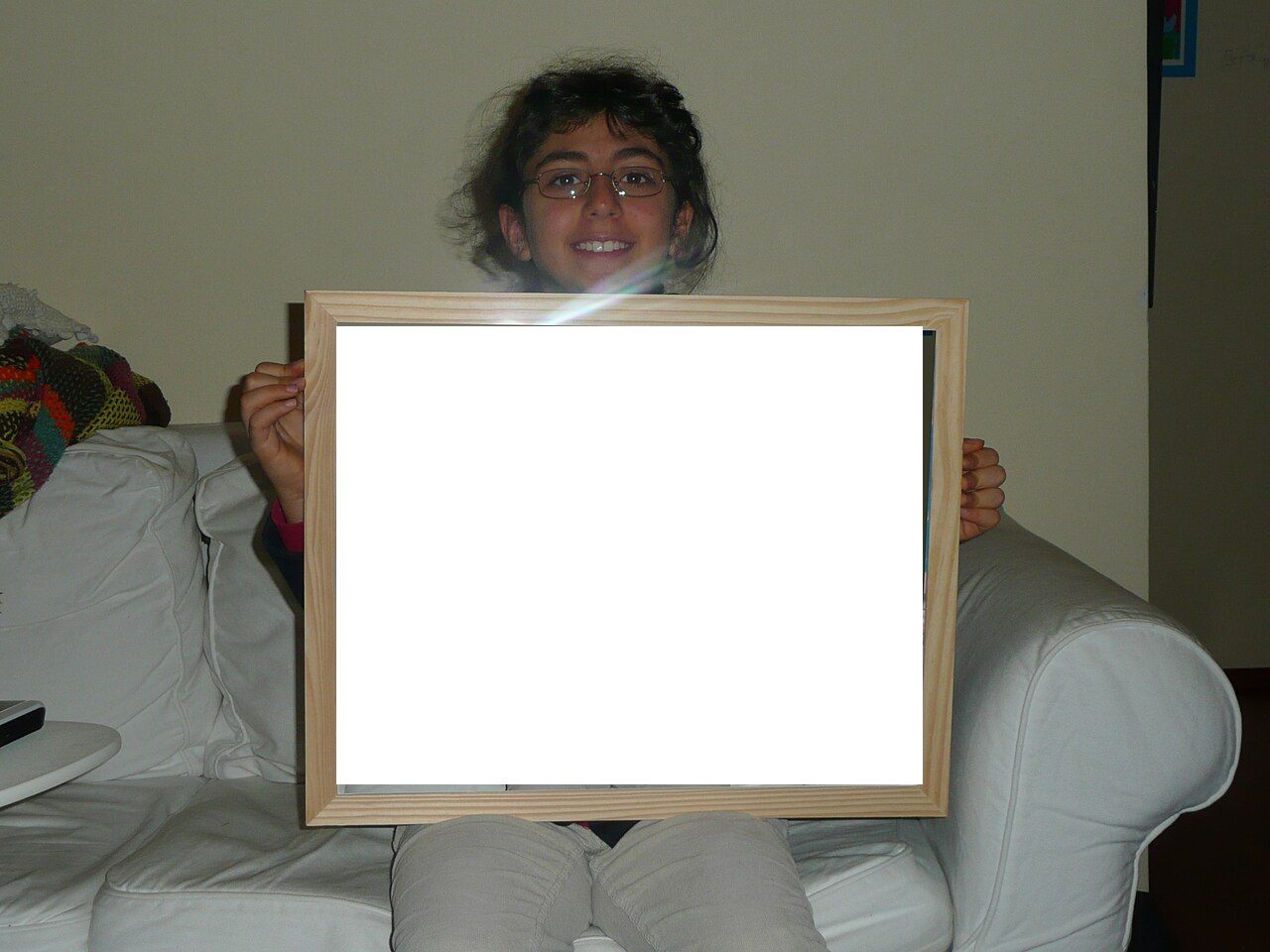
Now do one thing to it. Take the whole photo — couch, smile, frame and all — shrink it, and slot it into that empty frame. The frame isn't empty now; it holds the photo. But the copy you just dropped in has a frame of its own, and that one is empty. So fill it the same way. And the copy inside it. There is no last step.
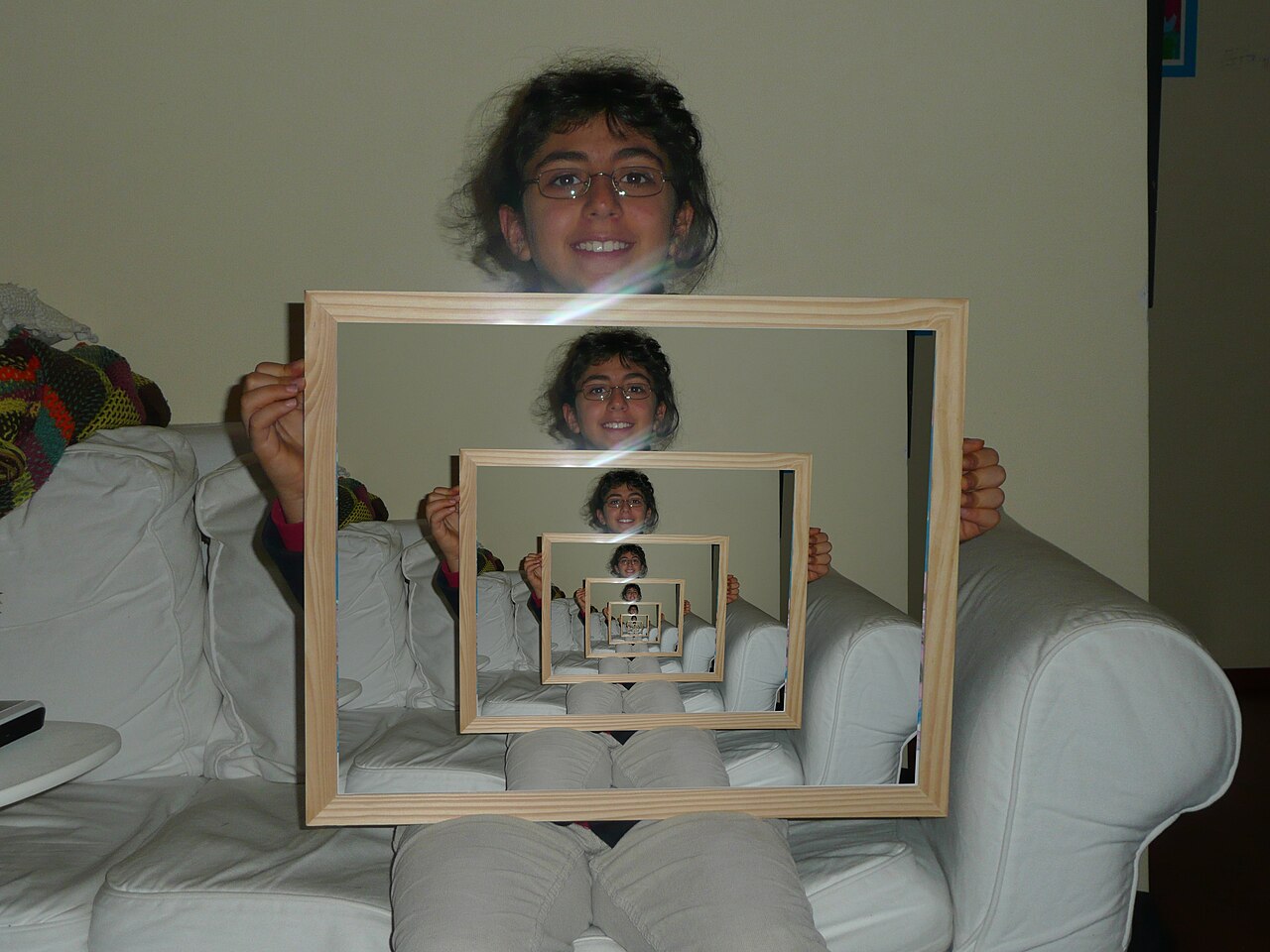
That is the Droste effect, after the 1904 cocoa tin that used it. Each copy sits squarely inside the last, the same shape a fixed fraction smaller, and the picture falls straight toward its own centre — with no bottom to reach.
That straight fall is one kind of infinity. Here is a second: let every copy turn a little as it shrinks, and the stack winds into a spiral.
Turning-while-shrinking is one move, not two — but to see that, we need the idea Escher was unknowingly computing with when he drew his curved grid by hand. So before the spiral, a short detour through the kind of number that can hold a shrink and a turn at once.
Numbers that can turn
Think of the ordinary numbers as living on a line. Multiplication stretches that line about its centre, 0: multiply everything by 2 and every point lands twice as far out; multiply by ½ and the line contracts. One number is stranger. Multiply by −1 and the whole line flips around 0 — a half-turn.
Now ask a child's question: if −1 is a half-turn, which number is a quarter-turn? Half of a flip? No number on the line manages it. So invent one — call it i, and give it exactly one job: multiplying by i turns the plane a quarter-turn. Where must i itself live? Multiplying sends 1 to 1 × i = i, and a quarter-turn carries 1 to the spot one unit above 0 — so that is i's address: just off the line, one step up. And doing the job twice is the flip: i × i = −1. That famous equation, usually served as a pill to swallow, is plain geometry — a quarter-turn, done twice, is an about-face.
The moment you allow i, every point of the plane becomes a number. The point 1.1 across and 0.6 up is the number 1.1 + 0.6i — the i tags the up-part. These are the complex numbers, and the name slanders them; they are simpler than what they do. Multiply the plane by any one of them, c, and two small facts pin down the entire move: 0 × c = 0, so the centre stays put; and 1 × c = c, so the point 1 lands exactly on c. The rest of the plane follows as rigidly as it can. Every multiplication is a scale-and-spin about the centre — never a squash, never a shear. Where 1 lands tells you everything.
Now look back at the Droste photo. “Every copy shrinks by the same step” means the picture doesn't change when you multiply it, about its centre, by an ordinary number — its shrink factor. A tententoon is the same sentence with the number moved off the line: a picture that doesn't change when you multiply it by a complex number — a shrink with a turn folded in. The rest of this page is one question: how do you paint such a picture?
A function moves the plane
A function is a rule with an input and an output. For us the input is a point of the plane — which is now a number, z — and the output is another point:
z → f(z)
So if z is one point on the picture, f(z) tells us where that point goes. Now do it for every point at once. The grid moves. The rings move. The photo moves. That is all a warp is: one function, evaluated everywhere.
Below, the left plane is the input and the right plane shows where everything lands. The red line is the ordinary number line; the blue one is the up-direction where i lives; the readouts underneath write each point in the across-plus-up notation from a moment ago. And the small orange square glued to your point is the real experiment: whatever a function does to the whole plane, watch what it does to that square.
Start by clicking f(z) = 2z and watch the plane stretch away from the centre. Park the dot on the little point marked 1 and read the output: it landed on 2. Then click iz — the quarter-turn, no longer a claim but a thing you can drag. The formula stops being a formula; it becomes a machine moving the plane.
The identity → function slider doesn't jump straight to f(z); it pulls the plane there continuously, so you can watch the motion instead of just the before and after. (That in-between is a teaching aid, not the real map.)
Walk down the list and the moves get bolder. f(z) = z leaves every point exactly where it was — dull, but it's the baseline. 2z doubles every distance: pure scale. iz is the quarter-turn: pure spin. And c·z is the general case with the constant handed to you — grab the gold dot and steer the multiplication yourself. Push c out along the red line: pure zoom. Swing it around the centre: pure turn. Park it anywhere else and the two fuse into a single scale-and-spin, with the point 1 landing on c every time and the whole plane following rigidly behind it. Keep a hand on that dial; it is exactly the move the spiral will need.
Then the plane starts to bend. f(z) = z2 squares each point — distances get squared while angles double, so the grid fans out and curves. But watch the orange square ride through: carried, turned, resized — still very nearly a square. File that oddity away. It is the only reason a photograph will survive what we are about to do to one.
The next two are the pair this whole page turns on, and you don't need their formulas: on this page exp is the roll-up machine and log is the unroll machine. exp reads a point's two coordinates separately. The across-part sets the output's size: each step right multiplies the distance from the centre by a fixed factor. The up-part sets its direction: climb one unit and the output swings one radian around. So climb 2π — one full turn's worth, about 6.28 — and the output comes all the way around. This input plane is exactly 2π tall on purpose: pick exp and drag your point straight up, bottom edge to top, and its image sweeps one complete lap and comes home. Upright lines roll into rings.
log is the undo. Pick it, swap the grid for the rings, and watch every circle snap out into an upright line. Then show the photo with log still chosen: you have just taken the logarithm of a picture. Hold that thought.
With log, if the dot's image suddenly teleports from the top of the panel to the bottom: that's the seam where we cut the unrolling. A circle has no start, so one panel can only show one lap's worth; the unrolled plane truly continues above and below, forever. You'll see it do so in a moment.
One button doesn't belong. The last one is written as a recipe on plain coordinates — so much per x, so much per y — rather than as complex arithmetic, and it bends the grid as bravely as z2 does. But press it and watch where the orange square lands: sheared into a parallelogram. No complex function ever does that. Before the page ends, that one shear will turn out to be the difference between Escher's picture and mush.
The function we need
Now we can state the job. We have a Droste image: it repeats when you zoom in by its shrink factor S — for our photo, each copy is about 2.1× smaller. We want to rebuild it so that it repeats under a complex multiplication instead: turning and zooming folded into one motion, so that walking once around the centre carries you exactly one Droste step inward.
Housekeeping first. Multiplication scales about 0, and log unrolls rings around 0 — so slide the picture until its vanishing point, the spot all the copies fall toward, sits at the centre. Call that point z0; it is the z − z0 in the formulas over the panels.
From the playground we already own all the parts, and the plan is three moves: log to unroll the rings into a flat repeating strip, one scale-and-spin — a single complex multiplication — to lean that strip, and exp to roll it back up. Below: the original, then the three moves, wired together live — touch any control and the whole row answers. Click ring as the source once and follow the thick red ring across the row: an upright red line in the flat strip, the same line leaned over, and at last a red coil in the spiral. One ring, traced through the entire machine.
This live pipeline needs WebGL2 and JavaScript. In short: flatten the nested frames into a repeating strip, lean the strip to the angle where its tiles still line up, and roll it back up — the lean becomes the spiral.
The photo's own nesting is gentle (S ≈ 2.1), so it closes at only about 7°. The ring and grid patterns repeat at every scale, so they ride a bolder geometry (S = 20) and close at ~25.5°; overlay is the photo with the patterns inked on, and closes with the photo. Switching source resets the lean to the new closing angle. The law behind these numbers is waiting in step 2.
Before reading on, do one thing. Drag the lean slider on the second move off its mark and watch the spiral on the right tear at its seam. Now press snap. That click — the tiles sliding back into register, the frames lighting up — is the entire content of the next three sections. All we are going to do is slow it down.
1 · We log it
Start with the turning. A ring around the centre has no end: travel round it, return to your mark, set off again, as many laps as you please. Lay that trip out straight and it's a line on which one lap repeats, then an identical lap, then another. Going around always brings you home — so flattened, the picture is periodic: shift it by one lap and nothing has changed.
Going inward usually breaks the spell — zoom toward the middle of an ordinary photo and you meet new detail forever, never the same view twice. The Droste is the exception, and we built it on purpose: one frame inward is an exact copy of the whole, so inward repeats as well. Flatten both directions and the picture becomes a plain grid of identical tiles. This flattening is exactly the playground's log: a point's distance from the centre becomes how far across it sits, and its angle around becomes how far up. Distance is traded for shrink-steps — multiplying turned into adding — and that trade has a name you already know: the logarithm. You are looking at the log of a photograph.
Read a tile's dimensions off the strip. It is one lap tall — 2π, because going around is 2π radians' worth of turning — and one shrink-step wide: log S, the number over the first panel, because that is what a zoom of S adds after the trade. Two ways home, two repeats: around brings you home in any picture; inward brings you home only in a Droste. So here is the quiet fact the whole spiral rests on: a step of exactly one tile lands you on a region identical to where you started. Don't take the page's word for it. Drag the strip sideways until the readout under the panels announces identical again ✓ — you just zoomed one whole Droste step. Drag it one tile vertically: identical again.
And a picture that repeats one step over and one step up is a picture you can lean without breaking. That lean is the entire trick. It's next.
2 · We bend it
Bending a spiral by hand is hopeless; leaning a flat grid is easy — that is the whole reason we flattened. And you have already felt this step: most angles drag the tiles out of step and the spiral tears, but at one angle the rows click back into register, every tile meeting its neighbours with no gaps and no overlaps. snap lands on it exactly. Call that angle β.
Why that angle? In the flat grid you live at many addresses at once. One tile to your right stands a copy of you, one shrink-step further in. One tile straight up or down stands another — you, one lap around. And one tile over, one tile down stands the copy reached by zooming and turning at once: the diagonal neighbour. Now remember what rolling up does: it glues each point of the strip to the point one lap below it. So the rolled-up picture is seamless only if one lap straight down lands on an identical copy. Upright, it does — but boringly: straight down is pure turning, and the roll-up gives back the plain Droste. Lean the strip until the diagonal neighbour stands directly underneath you instead, and one lap around now comes with one shrink-step folded in.
That one requirement fixes everything. The lean must stand a tile's diagonal — one shrink-step across, one lap up — on end, so tan β = log S ÷ 2π. There is the law behind the panel's numbers: the photo's gentle S ≈ 2.1 asks for just under 7° of lean, the bold patterns' S = 20 for 25.5°, and Escher's deep S = 256 demands a full 41°. And the lean itself is nothing new: it is the playground's c·z — one complex multiplication, a turn by β with a whisper of shrink folded in, sized so the upended diagonal measures exactly one lap. Nudge the slider and watch the constant follow in the header above the panel.
Steeper closings exist too: keep leaning, and at twice the tangent the copy standing one lap below you is the one two tiles over — the seam heals again, now diving two Droste steps per lap. With the photo as source, sneak the lean up to about 13.3° and watch the spiral quietly seal itself; the glow only honours the first angle, but the mathematics honours the whole family. One step per lap — the gentlest closing lean — is the clean single spiral Escher drew.
3 · We exponentiate it
One move remains: roll the leaned strip back up — the exact undo of the flattening. On the last panel, pull the flat ↔ spiral slider down to flat and slowly back up, and watch each upright line of the strip curl into a ring as exp winds it around the centre.
Now collect the winnings. Rolling up glues each point to the point one lap away — and the lean put an identical copy exactly there, one lap around and one tile inward. So the spiral meets itself with no seam, because the two edges being glued were identical before the glue. And the job we set ourselves is done: in the rolled-up picture, going around is going inward — walk once about the centre and you arrive one whole Droste step deeper. That is the tententoon.
Both infinities live at the two ends of the lean. Set it to 0° and the roll-up gives the straight Droste fall; snap it to β and the same roll gives Escher's spiral. Same picture, same roll — only the lean is different.
The algebra hands us a parting gift. The three moves were: take log, multiply by a constant, take exp — and exp(α · log z) collapses, the way exponents always collapse, into a single power. The entire machine above is the one-line function over the third panel,
w = z0 + (z − z0)α
— recentre on the vanishing point, raise to a complex power, done. The whole lean hides inside the one constant α. Months of Escher's labour, five symbols — though the symbols come cheap only because the understanding didn't: everything the formula knows, you now know.
For the sharp-eyed: the α in the panels is the lean's reciprocal, because a renderer runs the machine backwards — for every point of the finished spiral it asks which point of the straight picture supplies its colour (that's the word lookup in the second panel's header). Same machine, read right to left.
Before we leave the machine: scroll back to the dictionary card at the top of this page and look at the stamp in its corner — squares turning 22° as they shrink. You have been looking at a tententoon since before you knew the word. And now you know how to build one.
Why the picture still looks like a picture
A puzzle is left over. We just bent a photograph around a spiral — why didn't it turn to mush? A careless warp wrecks an image: squares shear into parallelograms, faces smear, straight edges buckle. Escher needed the opposite — an enormous global bend in which every small neighbourhood stays almost untouched.
Earlier, you filed an oddity away. Go back to the playground and run the comparison: press the not complex impostor and watch the orange square land sheared; then press z2 and drag the same path — bent, turned, resized, still square. Both recipes are smooth. Only one respects shape. The difference is that the impostor handles x and y as two separate ingredients, while z2 is built from complex arithmetic alone.
Here is the why, and it is the payoff of the whole detour. Zoom far enough in on any function built from complex arithmetic — z2, exp, log, the tententoon power itself — and near a single point it becomes indistinguishable from one multiplication by one constant. (That constant is the function's rate of change there; having one is what differentiable means, drawn instead of graphed.) And a multiplication, you now know by heart, is a scale-and-spin: never a squash, never a shear. So the plane as a whole may twist violently around itself while every little square stays a little square — only bigger or smaller, only turned.
The orange square is drawn at a fixed size, so it bows slightly where the warp is wild. Imagine it smaller and the fit sharpens without end.
That is why this family of functions is the right tool for warping a photograph, and the quiet reason the spiral still reads as a gallery rather than a smear. Write nearly any formula in z and this shape-faithfulness falls out free; write an honest recipe on x and y and it almost never does. Mathematicians call such maps conformal. Escher, with no formal mathematics at all, demanded exactly this of his hand-drawn grid — look closely at it and all his curved lines cross at right angles.
Escher got there first, by hand
Escher had no computer in 1956 — and no complex numbers either. He started from the idea of a straight Droste scene: a gallery containing a print containing the gallery, nested squarely like our couch photo, each copy 256 times smaller. Then he worked the curved grid out by eye — spreading that zoom around the loop as four gentle steps of 4, one per quarter-turn — ruled it onto the paper, kept every crossing at right angles, and copied the scene into the bend square by little square. And he got it right: the mathematics later showed his by-eye grid was very nearly exact. You found your closing angle by nudging a slider until a frame glowed. Escher found his with a ruler, an eraser, and what he described as almighty headaches.
But a spiral tightens forever toward its centre, and a pen can only go so fine. So Escher stopped, left a soft white disc in the middle, curled his signature into it, and called it finished. Stand at the rim of that disc and try to say what should continue into it. Coming from the upper right, surely rooftops. From the left, the moulding of the picture frame. From below, the gallery floor. Every answer is correct — all the picture's ambiguity about where you are drains into that one blank circle, the one place the picture could not finish itself.
The map that filled the hole
In 2003, two mathematicians in Leiden — Bart de Smit and Hendrik Lenstra — worked out the exact map hiding in Escher's grid. The idealised Print Gallery, they showed, contains a complete copy of itself rotated by 157.6256° and shrunk by a factor of 22.5837. Pause on that pair: a turn and a shrink, fused — one complex number. The picture Escher drew by instinct is, to the millimetre his pen could manage, a picture that doesn't change when you multiply it by a single complex constant: the very thing this page called a tententoon back when the word was first on the table. Escher computed a complex multiplication without ever writing a complex number down. Pin that one constant, and the rest of the picture is forced — including the part he left blank.
And the map says: there is no hole. The flat strip runs on forever, so its roll-up fills every point of the plane except the exact centre — a single dimensionless dot. What belongs in Escher's blank disc is the whole picture again — gallery, print, town, young man — turned 157.6° and 22.6× smaller, holding a smaller copy still, all the way down. The blank was never a gap in the picture, only in what a pen can do. So they computed it: the spiral continued inward, far past any draughtsman's hand, and the white disc closed at last, almost fifty years after Escher signed his name across it.
A last secret, then. A pattern that repeats in two directions at once — the tiled strip you dragged around above — is the home ground of what mathematicians call elliptic curves, a pillar of modern number theory. De Smit and Lenstra are number theorists; where the rest of us saw a curiosity, they recognised an old friend. The structures Escher was drawn to by pure instinct sit a short walk from the research frontier — which may be the deepest compliment mathematics can pay a draughtsman.
See it move
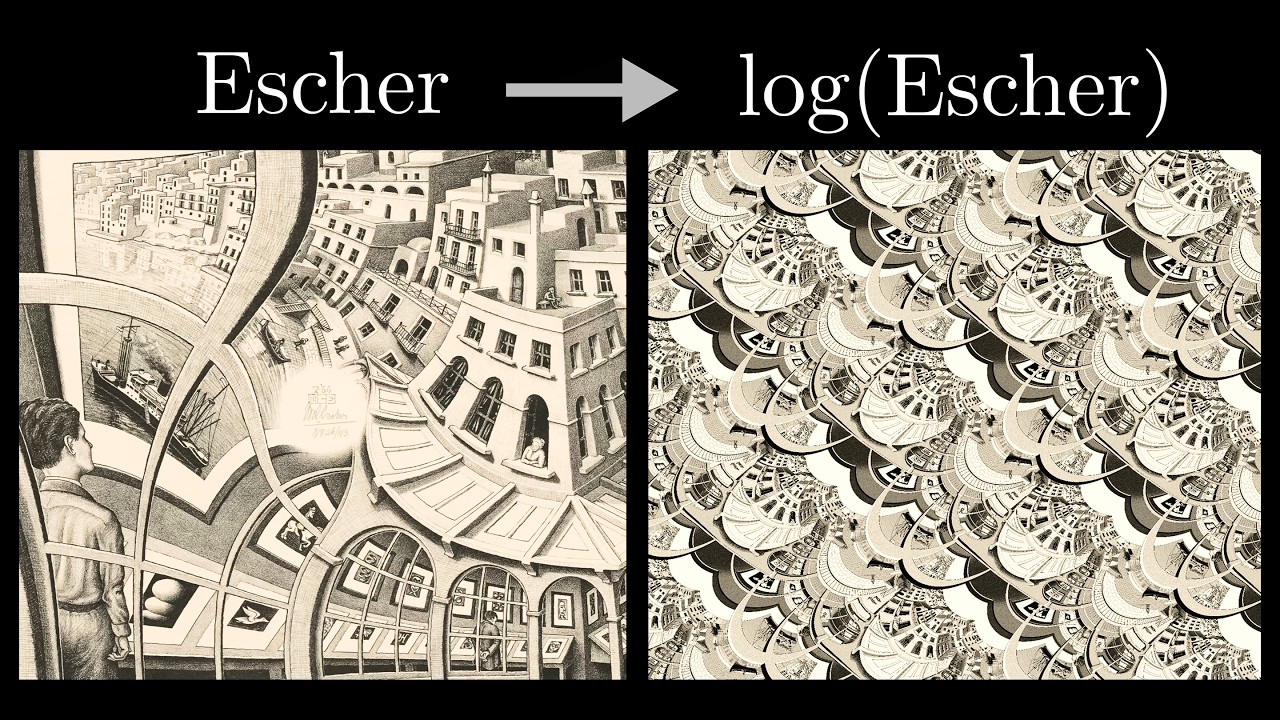
If you'd like the whole argument animated, Grant Sanderson (of 3Blue1Brown) made a tour of the de Smit–Lenstra paper in 2026 — the very log(Escher) step you just played with, and more.
Now make one
This tool does the bending for you. Drop in any photo, draw the rectangle where the next copy should sit, and flip between the two infinities: the straight Droste fall, or the tententoon spiral. Export the loop as a PNG, a GIF, or a video. It all runs in your browser: no upload, no account, no server.