ten·ten·toon /ˌtɛn.tɛnˈtoːn/ noun
1. a self-repeating image whose copies spiral as they shrink, in the manner of M. C. Escher's Print Gallery.
• a tententoon of the old gallery, winding inward without end.
Origin coined from the Dutch Prentententoonstelling (“print exhibition”): prenten, prints + tentoonstelling, exhibition. The coined word sits right where the two halves meet.
What if outside and inside had no border?
A picture that contains a smaller copy of itself is called the Droste effect, after the 1904 Dutch cocoa tin whose nurse carries a tray bearing the very same tin. You can fall inward forever — yet every copy stays fenced inside its own frame, cleanly separating the world outside from the miniature world within.
What if that boundary dissolved? Follow the painted wreath around the portal below: instead of closing into a separate ring, the frame itself spirals inward, carrying the outer room seamlessly into the smaller room inside it. Here is the four-step machine that weaves them together.
Flatten the nested rings with a logarithm, tilt the strip until adjacent copies line up, and roll it back up with an exponential.
Drag panel 1 In panel 1, the circular celestial & botanical wreath unrolls into tall vertical friezes (sun face at the top, stars, gears, and vines along the sides, red compass star at the bottom). Grab panel 1 and drag left or right to zoom the round panels in and out, or drag up and down to turn them.
Break & snap the seam Move the lean slider in panel 2 off 12.1° and watch a sharp seam open up in panel 3. Press snap to lock back onto β = arctan(ln S / 2π), where the top of one painted frieze meets the bottom of the next.
Unroll the spiral
Pull the flat ↔ spiral slider in panel 3
left and right to watch exp curl the tilted friezes into the
finished celestial & botanical nautilus spiral.
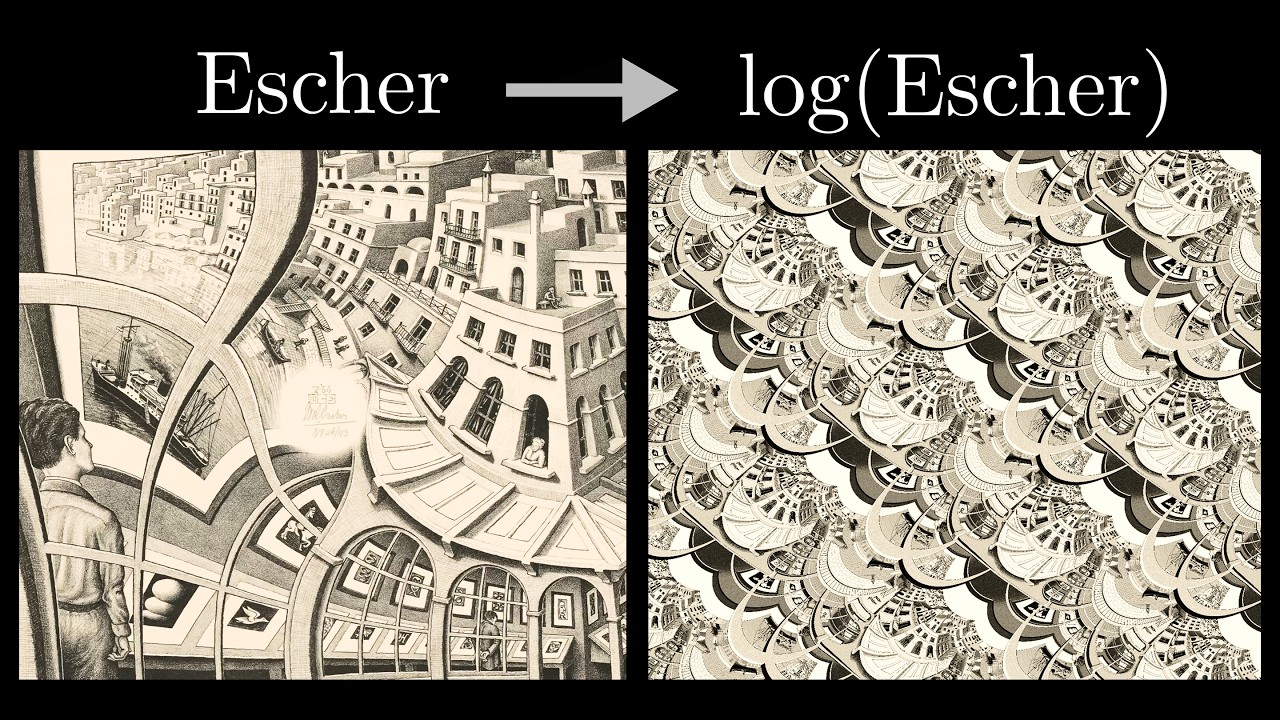
The full story, told by 3Blue1Brown
In 2003, Bart de Smit and Hendrik Lenstra uncovered the complex-plane geometry behind M. C. Escher's 1956 lithograph Print Gallery. Grant Sanderson walks through every piece of that discovery visually.
Warm-up: feel individual complex functions
If you want to see each building block in isolation — how multiplying by a
complex number scales and rotates, or how log(z) and
exp(z) unroll and re-roll circles — pick a function below and
drag the orange point on the input plane.
Turn your own picture into a tententoon
Open the studio, drop in any photo, and place the portal frame over a window, mirror, or lens. You can export high-resolution stills or smooth looping videos — everything runs in your browser.